
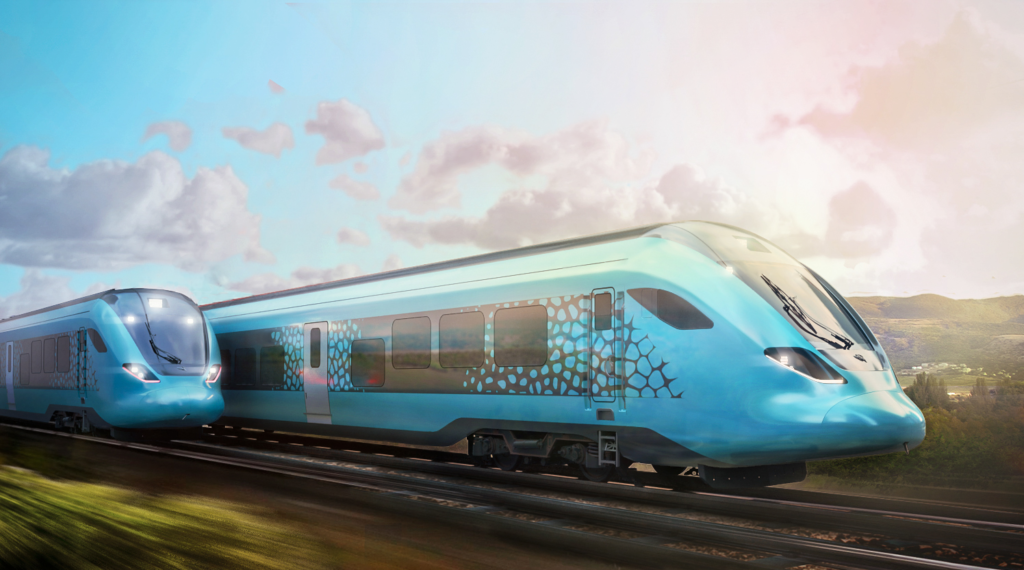
- The technology will be tested in its initial phase in 2021, with subsequent installation between 2021 and 2023.
The hydrogen train will be called Talgo Vittal-One, a reference to hydrogen’s place on the periodic table.
Hydrogen technology is an emission-free alternative for non-electrified lines, where diesel trains currently operate.Talgo unveiled this Thursday the manufacturing and commissioning schedule for the future hydrogen train, a green, innovative, and efficient alternative to replace diesel locomotives, which will be ready in 2023. The train will be named Talgo Vittal-One, with “One” referring to hydrogen’s place on the periodic table, number one. The details were presented during the event “Renewable Hydrogen: An Opportunity for Spain,” organized by the Ministry for Ecological Transition and the Demographic Challenge.
The hydrogen technology validation tests on track will be carried out in the first phase in 2021. Following validation, the hydrogen technology will be installed on the new train in a second manufacturing phase, which will take place between 2021 and 2023.
The company’s CEO, José María Oriol, said during his speech: “Green hydrogen is no longer the future; it’s a reality. The implementation of hydrogen trains like the one Talgo is developing will improve mobility in our country while protecting the environment, as it will allow us to take advantage of non-electrified Spanish lines while reducing our carbon footprint.”
This system is configured as a modular solution that allows for installation on all types of trains, as well as for conversions from diesel to hydrogen. However, it has been specifically designed for the Vittal platform for commuter and medium-distance trains, with which Talgo competes in various bidding processes in Spain and other countries.
Hydrogen-powered trains
This innovative system uses hydrogen fuel cells to power the train’s electric motors. It is powered by renewable energy sources, such as solar photovoltaic or wind power, which produce hydrogen that is stored and subsequently used to power advanced fuel cell-based propulsion systems, such as the one designed by Talgo. The system is complemented by batteries that increase the acceleration available during takeoff, taking advantage of the train’s braking to recharge.
Unlike battery systems widely used in automotive vehicles, hydrogen (H2) technology is presented as the logical answer to the needs of heavy transport and, in particular, those railway lines that do not have catenary electrification systems and currently rely on trains powered by diesel engines. The hydrogen system designed by Talgo thus makes it possible to “electrify” conventional network lines without the need for costly and lengthy adaptation works, dispensing with the use of fossil fuels.
About Talgo
Talgo S.A. is the leading company in the design, manufacture, and maintenance of high-speed light rail systems, with industrial presence in seven countries: Spain, Germany, Kazakhstan, Uzbekistan, Russia, Saudi Arabia, and the United States. The company is recognized worldwide for its innovative capacity, distinctive unique technology, and reliability. Talgo is the train supplier for the high-speed “Haramain” railway project between Mecca and Medina in Saudi Arabia, and its customers include the railway authorities of Germany, the United States, and Russia.
More information
