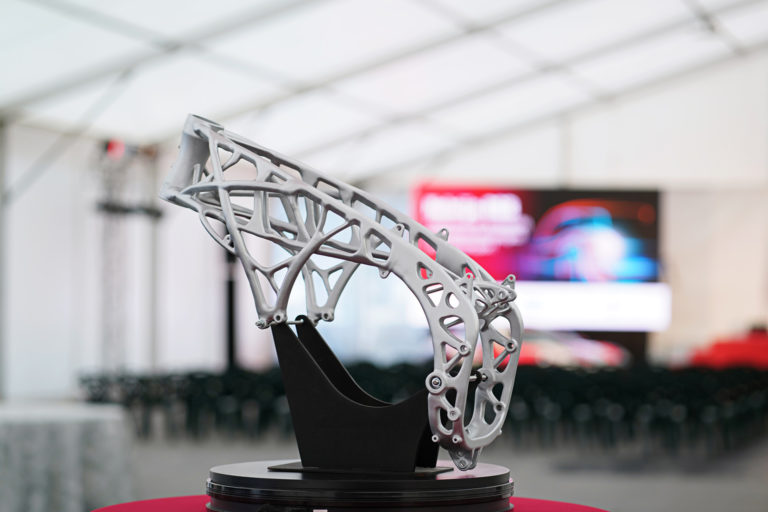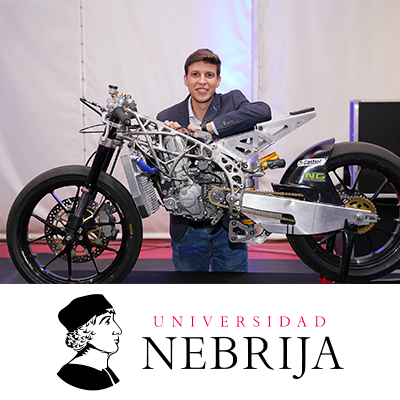
Generally, the most widely used material in the motorcycle world is aluminum, with some exceptions for steel. Characteristics such as lightness and certain properties that, after years of research, provide a motorcycle with excellent performance, have been key factors in making this material a common denominator in any chassis. Achieving this same component in steel that conveys similar riding sensations and performance is one of the milestones achieved by this alliance between ArcelorMittal and Nebrija.
AMM – How did the opportunity to collaborate with ArcelorMittal arise?
S. Corbera – ArcelorMittal has a technological innovation center focused on the development of several cutting-edge technologies: 3D printing, artificial intelligence, nanotechnology, and green energy. Nebrija University integrates artificial intelligence techniques and generative models—intelligent design or generative design—to develop innovative products in the automotive sector. 3D printing and the development of generative design algorithms are very closely related, so it was felt that the collaboration between both parties could lead to high-value products. The relationship began with the motorcycle chassis, but has now evolved into a full-fledged, high-tech development line that seeks to develop new, innovative products.
AMM – Can you tell us about the project development process? Any anecdotes or obstacles that stood in the way?
S. Corbera – Project development begins by defining the chassis’ boundary conditions, establishing the objectives to be achieved, integration into the motorcycle, control volumes, etc. It all begins with a blank sheet of paper on which all these aspects are captured, and the initial volume from which the chassis will be built is generated. From this point, different geometric chassis options were initially generated using topological optimization integrated into commercial software such as ALTAIR, ANSYS, and PARAMETERS. These initial geometries did not meet all the established requirements due to their complexity. They acted as geometric seeds that were subsequently evolved and optimized by algorithms developed at Nebrija University, primarily evolutionary algorithms. These algorithms combined the different geometric solutions and performed geometric evolutions to meet all the requirements. Aspects such as printing angles, number of supports, stiffness balance, and weights are some of the conditions we introduce into the algorithms. Once the geometric shape was obtained, the ArcelorMittal R&D team began evaluating the viability of the printing process: stability, heat dissipation, partitions, geometric modifications, etc. This phase of ensuring the optimal design could be manufactured without problems is an arduous task, one that ArcelorMittal had to invest significant resources into. There were no problems as such, but in such a complex process, complications arise that can jeopardize the final objective. The chassis has very small thicknesses, so one of the most critical points was ensuring that no problems arose during the printing process. The inherent deformation of the geometry due to temperature during the printing process was another unknown that could lead to complications, as was the presence of pores or small cracks. All of these were critical steps that could be evaluated and resolved as the process progressed. These are very difficult aspects to control a priori since such a large and complex part had never been produced, so all this acquired know-how is already a success for the collaboration.
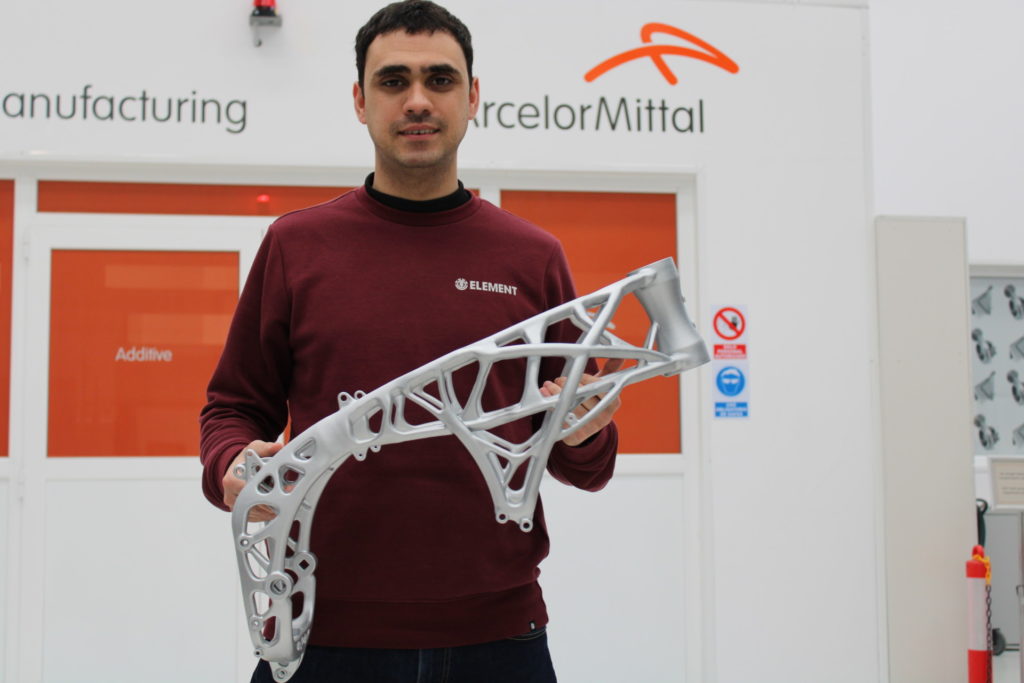 Daniel Vázquez, Ingeniero de diseño de ArcelorMittalAMM – What technology is behind the project?
S. Corbera – The project combines two highly innovative and rapidly developing areas: additive manufacturing and generative design. The former was managed by ArcelorMittal and utilized its facilities and sophisticated 3D printing technologies. The chassis was manufactured using Selective Laser Melting (SLM) technology, one of the most well-known in the sector. Regarding the generative design phase, topology optimization algorithms and evolutionary algorithms were used to generate the entire chassis’ geometric shapes.
AMM – What are the main advantages of this project? What needs does it address, and how can it improve the lives of companies or sports teams?
S. Corbera – If we focus solely on the development of the chassis, the main advantage is associated with the freedom of geometric shapes that additive manufacturing allows. This technology opens the way to exploiting the full potential of design techniques governed by intelligent algorithms. The ability of these algorithms to explore the design space has allowed for an optimal chassis rigidity balance (a very important aspect for the driver’s feeling), with reduced weight and innovative geometry. In this sense, the geometric freedom of the manufacturing process, together with the potential of intelligent design techniques, allows for products that are closer to the optimum sought by the engineers, whether in terms of performance, weight, or cost. Another key point of the process was the possibility of developing the hollow chassis with wall thicknesses of 0.8-1 mm. This involved addressing several delicate issues within additive manufacturing: part stability during the printing process due to the very small thicknesses; control of porosity and mechanical properties at these thicknesses; and orientation of the geometric shape to avoid internal supports. These unknowns were resolved throughout the research process thanks to certain properties that steel contributes to the printing process, which made the production of hollow parts possible.
AMM – What are the next steps for this project?
S. Corbera – The next steps in the project are its validation under real-life conditions, on a track. We are beginning a progressive testing phase to confirm the chassis’ response. Being 3D printed, there are several uncertainties that we must address and confirm. How it responds to a strong impact, the feeling it transmits to the driver in low/medium and high-speed corners, and its structural integrity over time are some of them. All have been previously evaluated through simulations, but there is always a gap between simulation and reality, which we must narrow down during this phase. The testing program consists of different phases, beginning at low speeds and on small tracks and then moving on to much more demanding conditions until finally validating the chassis for a full championship. The goal is to confirm that this technology is feasible for the development of future motorcycle and car components under the same safety and performance requirements as those designed using traditional techniques.